There is something quietly irresistible about a farmhouse stay. Maybe it is the slow mornings, the open fields, the wooden porch with a view, or the feeling that time has finally stopped checking its watch. In a world of packed hotels, crowded attractions, and vacations that sometimes feel more exhausting than everyday life, a farmhouse stay offers something different: space, stillness, fresh air, and a closer connection to the place you are visiting.
But here is the catch. Not every farmhouse stay is built for the same kind of traveler.
Some are rustic and simple, made for people who want muddy boots, farm animals, and coffee outside while the countryside wakes up. Others are polished and luxurious, with deep bathtubs, designer kitchens, fireplaces, and views that look like they were made for a travel magazine cover. Some are perfect for families with kids. Some are better for couples who want privacy. Some are ideal for food lovers, solo travelers, digital detoxers, nature seekers, or anyone who simply wants a weekend that feels slower and softer.
Choosing the best farmhouse stay is not about finding the prettiest listing online. It is about finding the one that fits the way you actually like to travel.
Before you book the charming cottage with the ivy-covered walls or the restored barn with the mountain view, it helps to know what kind of experience you want. Do you want quiet or activities? Comfort or simplicity? A remote escape or easy access to restaurants and shops? A place where the kids can run around safely, or a private retreat where nobody interrupts your morning coffee?
The right farmhouse stay can turn a simple trip into something memorable. The wrong one can leave you wishing you had asked a few more questions before clicking “book.” This guide will help you choose a farmhouse stay that matches your travel style, your budget, your comfort level, and the kind of countryside escape you are really looking for.
1. Know What Kind of Traveler You Are
Before you fall in love with the first dreamy farmhouse photo you see, pause for a second and ask yourself a simple question: what kind of trip are you actually trying to have?
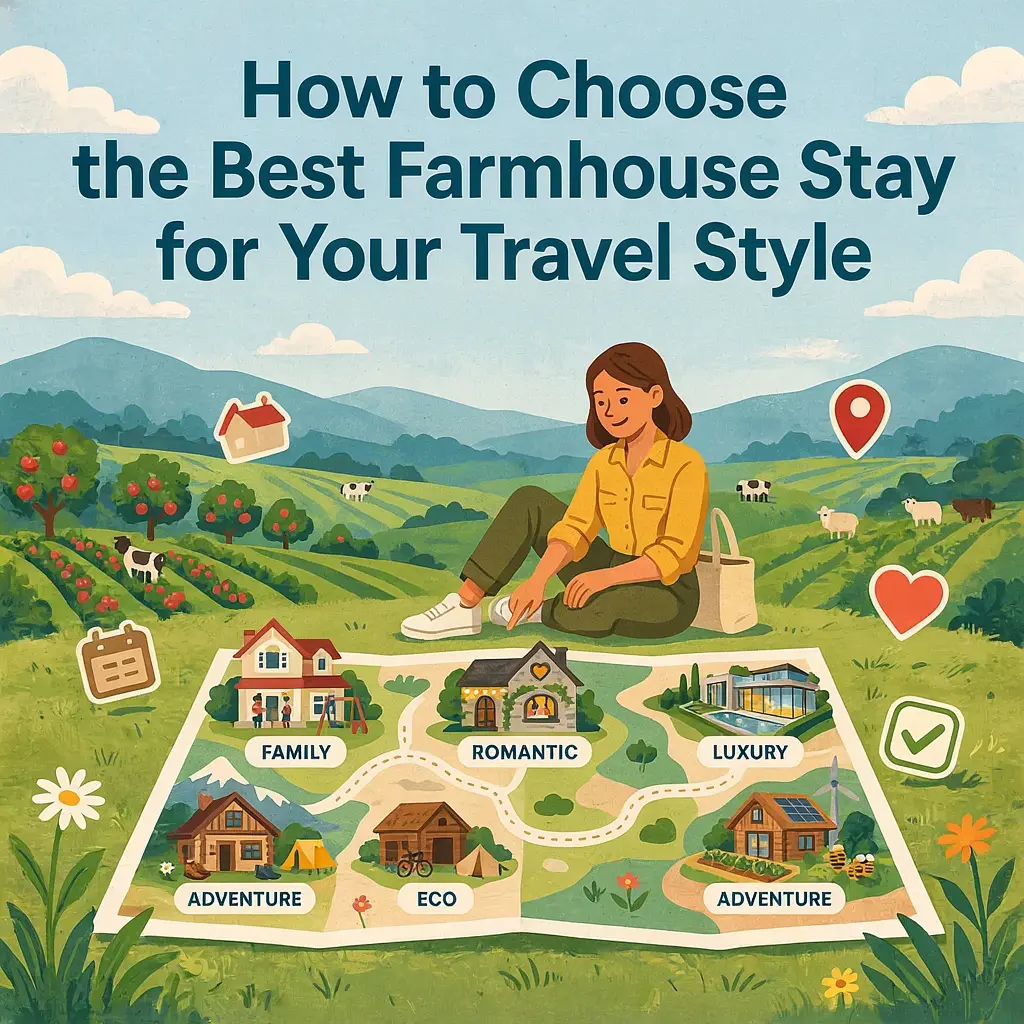
Because the best farmhouse stay for a romantic couple may be completely wrong for a family with three kids. A solo traveler looking for peace may not want the same place as a group of friends planning long dinners, wine, music, and late-night conversations under the stars. A traveler who wants to wake up early, feed animals, and pick vegetables will need a different kind of stay from someone who simply wants a beautiful countryside cottage with a soft bed and a bathtub.
Your travel style should guide the entire decision.
If you are planning a romantic escape, look for privacy, cozy interiors, scenic views, and thoughtful details like a fireplace, outdoor seating, or a private hot tub. The goal is not just to stay somewhere pretty. It is to find a place that gives you room to slow down together.
If you are traveling with family, your priorities will probably be different. You may need extra bedrooms, safe outdoor space, kid-friendly farm activities, laundry access, and a kitchen where you can prepare simple meals. A farmhouse with animals, open fields, and easy-going hosts can turn a family trip into the kind of memory children talk about long after they get home.
Solo travelers may want quiet, safety, and a setting that feels welcoming without being overwhelming. A smaller farm stay with friendly hosts, peaceful walking areas, and comfortable common spaces can be ideal, especially if you want time to read, think, reset, or simply enjoy your own company without feeling isolated.
Nature lovers should look for stays near hiking trails, forests, rivers, mountains, or wide countryside views. Food-focused travelers may want working farms, orchards, vineyards, or places that offer farm-to-table meals. Luxury travelers should look for upgraded interiors, premium bedding, strong Wi-Fi, spa-like bathrooms, and polished design. Budget travelers, meanwhile, may care more about cleanliness, location, kitchen access, and value than high-end extras.
The point is this: do not choose a farmhouse stay just because it looks charming. Choose it because it fits the way you want to feel while you are there.
A good farmhouse stay should match your pace. If you want adventure, it should give you things to do. If you want rest, it should protect your quiet. If you want connection, it should offer warmth and character. Once you know what kind of traveler you are, the search becomes much easier.
2. Choose the Right Location
Location can completely change the mood of a farmhouse stay. Two properties can both call themselves “peaceful countryside retreats,” but one might be deep in the hills with nothing but birdsong and winding roads around it, while the other sits ten minutes from a small town with cafes, markets, and weekend events. Neither is better by default. The right one depends on the kind of trip you want.
If you want a true escape, a remote countryside farmhouse may be perfect. These stays are made for slow mornings, quiet evenings, long walks, and the kind of silence you rarely get in the city. They are ideal for digital detox trips, romantic weekends, writing retreats, or anyone who wants to feel far away from normal life for a while.
But remote also means practical details matter. You may need a car. Restaurants may be limited. Grocery stores could be far away. Roads may be narrow, dark, or difficult in bad weather. Before booking, check how far the farmhouse is from the nearest town, supermarket, pharmacy, and main road.
If you like the countryside but still want convenience, look for a farmhouse near a small town. This gives you the best of both worlds: open space and rural charm, plus easy access to coffee shops, local restaurants, markets, and attractions. It is a smart choice for families, first-time farm stay guests, and travelers who do not want to feel too cut off.
Mountain farmhouse stays are great for hikers, photographers, and travelers who love dramatic views. Vineyard or orchard stays are better for food and wine lovers who want tastings, seasonal produce, and a more curated rural experience. Coastal rural stays can be beautiful if you want a mix of farmland, sea air, and beach days.
The location should support your travel style, not fight against it. If your dream trip involves quiet and stars, go remote. If you want dinners out and local exploring, stay near a town. If you want nature, look at the landscape around the property, not just the farmhouse itself.
A beautiful farmhouse in the wrong location can quickly become inconvenient. A simpler farmhouse in the perfect spot can feel unforgettable.
3. Decide Between Rustic and Modern Comfort
Farmhouse stays come in many flavors. Some are charmingly rustic, with creaky wooden floors, old stone walls, vintage furniture, and mornings that smell like grass, coffee, and woodsmoke. Others are modern countryside escapes, polished with sleek kitchens, fast Wi-Fi, rainfall showers, heated floors, luxury bedding, and glass doors that open onto perfect views.
Both can be wonderful. The trick is knowing which one will make you happy.
A rustic farmhouse stay is best if you want character more than perfection. You may get exposed beams, antique decor, simple rooms, farm animals nearby, and a setting that feels lived-in rather than staged. These stays often have soul. They feel connected to the land, the history, and the rhythm of rural life.
But rustic does not always mean uncomfortable. It simply means you should pay closer attention to the details. Check if there is heating or air conditioning. Look at the bathroom setup. See whether the kitchen is fully equipped. Read reviews for words like “clean,” “comfortable,” “cozy,” and “well-maintained.” A rustic farmhouse can be magical, but only if the basics are handled properly.
Modern farmhouse stays are better for travelers who want countryside beauty without giving up convenience. These are the stays with plush beds, stylish interiors, strong showers, bright kitchens, smart TVs, hot tubs, and spaces designed for comfort. They are great for couples, luxury travelers, remote workers, and anyone who wants the farm experience during the day but hotel-level comfort at night.
This choice matters more than people think. If you love polished spaces, a very basic farmhouse might feel frustrating after the first night. If you want authenticity, a modern luxury barn might feel too designed and not earthy enough. Neither reaction is wrong. It is just about knowing yourself before you book.
Look carefully at the photos, but do not rely on them alone. Read the full description. Check what is included. Look for recent reviews. If the listing says “traditional,” “off-grid,” “simple,” or “back to basics,” take that seriously. If it says “boutique,” “renovated,” “luxury,” or “designer,” expect a more refined experience.
The best farmhouse stay is not always the most expensive or the most photogenic. It is the one that gives you the level of comfort you need to fully relax. Rustic or modern, simple or stylish, the right choice should feel like a place you can settle into, not a place you have to tolerate.
4. Check the Farm Activities Available
One of the biggest reasons people book a farmhouse stay is simple: they want more than a room. They want an experience. They want to wake up somewhere that feels alive, where the day might include fresh eggs, muddy boots, fruit trees, animals, open fields, and a host who knows the land better than any guidebook ever could.
That is why farm activities are worth checking before you book.
Some farmhouse stays are peaceful but hands-off. You get the cottage, the view, and the quiet, but not much else. Others invite you into the rhythm of the farm with activities like feeding animals, collecting eggs, picking fruit, walking through gardens, joining a farm tour, or learning how local food is grown and prepared.
If you are traveling with kids, activities can make the trip unforgettable. A simple morning feeding goats, seeing chickens, or picking strawberries can become the highlight of the entire vacation. Children often remember the small, tactile moments: the bucket in their hands, the dirt on their shoes, the animal they were nervous to touch at first.
For couples, the right activities can add charm without making the trip feel crowded. Think wine tasting, a private picnic, a cooking class, a sunset walk through the fields, or a quiet evening around a fire pit. These are the kinds of details that turn a farmhouse stay from “nice place” into “we should come back here.”
Food lovers should look for working farms, vineyards, orchards, dairies, or places that offer farm-to-table meals. Some stays include breakfast made with local eggs, homemade bread, seasonal fruit, honey, cheese, or vegetables grown right on the property. If food is part of why you travel, this can make a huge difference.
Nature lovers may want hiking trails, birdwatching, horseback riding, fishing, cycling routes, or guided walks. If your idea of a perfect trip includes being outside as much as possible, check what the property offers and what is nearby.
Before booking, ask whether activities are included or cost extra. Some farm stays include simple experiences in the price, while others charge for tours, meals, classes, tastings, or equipment. Also check if activities are seasonal. Fruit picking in summer, harvest events in autumn, and animal experiences in spring may not be available year-round.
The key is to match the activities to your travel style. If you want rest, choose a place where activities are optional and the atmosphere stays calm. If you want adventure, choose a stay with enough to do beyond sitting on the porch.
A great farmhouse stay gives you the kind of countryside experience you came for, whether that means hands-on farm life or simply watching it unfold from a comfortable chair with a warm drink in your hand.
5. Think About Who You’re Traveling With
A farmhouse stay can feel completely different depending on who is coming with you. The same quiet cottage that feels romantic for two people might feel too small for a family. The same lively working farm that keeps children entertained all day might feel too busy for a solo traveler looking for silence. Before you book, think carefully about the people on the trip and what will make the stay comfortable for everyone.
If you are traveling as a couple, privacy should be high on the list. Look for a farmhouse stay with a private entrance, a cozy bedroom, beautiful views, outdoor seating, and enough separation from the main house or other guests. Romantic farmhouse stays work best when they feel peaceful, intimate, and easy. You want space to slow down, cook together, watch the sunset, or drink coffee in the morning without feeling like you are sharing the moment with strangers.
For families, the priorities are more practical. You may need multiple beds, a safe outdoor area, a kitchen, laundry access, and activities that children can enjoy without constant stress. A family-friendly farmhouse should have room to move, clear house rules, and hosts who are comfortable welcoming younger guests. Farm animals, gardens, swings, open lawns, and simple nature walks can make the stay feel exciting without needing a packed itinerary.
If you are traveling with a group of friends, look for space that brings people together. A large kitchen, long dining table, fire pit, outdoor seating area, barbecue space, and multiple bathrooms can make a big difference. Group trips need comfort, but they also need flow. Nobody wants to spend a weekend fighting over one tiny bathroom or trying to cook dinner in a kitchen built for two.
Solo travelers should pay close attention to safety, location, and the general feel of the property. A farmhouse stay can be a beautiful place to reset, read, work, reflect, or simply enjoy your own pace. Look for strong reviews, responsive hosts, easy check-in, good lighting, secure access, and a location that does not feel too isolated unless that is exactly what you want.
If you are traveling with older relatives, accessibility becomes even more important. Check for stairs, uneven paths, bathroom layout, parking distance, heating, air conditioning, and how easy it is to get around the property. Some old farmhouses are full of character, but not all are easy for guests with mobility concerns.
And if you are bringing a pet, do not just look for the words “pet-friendly.” Read the rules carefully. Some places allow pets only in certain rooms. Others may have farm animals, fences, or outdoor areas where pets need to stay on a leash. A farmhouse can be wonderful for pets, but only when the setup is safe and clearly explained.
The best farmhouse stay should fit the whole group, not just the person booking it. When everyone has enough space, comfort, and freedom to enjoy the trip in their own way, the experience feels smoother from the start.
6. Look Closely at the Amenities
Amenities may not sound as romantic as orchard views or a porch facing the hills, but they can make or break a farmhouse stay. A beautiful property is much easier to enjoy when the practical things are handled well. Comfort is not the enemy of charm. In fact, it is often what allows you to enjoy the charm properly.
Start with the basics. Does the farmhouse have reliable heating or air conditioning? Is there a private bathroom? Is the bed comfortable? Is there hot water? Are towels and linens included? These may seem obvious, but older countryside properties can vary widely. A farmhouse can look stunning in photos and still be uncomfortable if the essentials are weak.
Wi-Fi is another big one. If you are planning a digital detox, you may not care. But if you need to work remotely, check messages, stream movies, research nearby attractions, or keep children entertained during downtime, reliable internet matters. Do not just look for “Wi-Fi included.” Read reviews to see if guests mention the speed and consistency.
Kitchen access is especially important for remote farmhouse stays. If restaurants are far away, a good kitchen can save the trip. Look for a refrigerator, stove, microwave, coffee maker, utensils, cookware, and enough dining space for your group. Even if you do not plan to cook full meals, being able to make breakfast, tea, snacks, or a simple dinner adds comfort and flexibility.
Parking is another detail worth checking. Some rural stays have easy on-site parking, while others may require you to park farther away or drive along narrow farm roads. If you are arriving late, traveling with kids, bringing luggage, or renting a car, easy parking can make the arrival much smoother.
Outdoor space is one of the pleasures of a farmhouse stay, so look at what is actually available. Is there a private patio, garden, fire pit, barbecue area, balcony, or shared courtyard? Are guests allowed to walk around the farm? Can children play outside safely? Are there fences, ponds, animals, or equipment nearby that require extra care?
If you are traveling with pets, read the pet policy carefully. “Pet-friendly” can mean many different things. Some places allow pets inside. Others only allow them in certain areas. Some charge extra fees. Some farms have animals, open land, or rules about leashes. The clearer the listing is, the better.
Breakfast can also change the experience. Some farmhouse stays include homemade breakfast with local eggs, bread, fruit, jam, honey, or fresh coffee. Others are self-catering only. Neither is wrong, but it is better to know before you arrive. A farm-to-table breakfast can be a beautiful bonus, especially if food is part of why you chose the stay.
The smartest approach is to make a short list of your non-negotiables before booking. For some travelers, that might be Wi-Fi, air conditioning, and a private bathroom. For others, it might be a kitchen, pet-friendly rules, and outdoor seating. Luxury travelers may care about bedding, bathrooms, hot tubs, and design. Families may need laundry, space, safety, and child-friendly features.
A farmhouse stay does not need every amenity in the world. It just needs the right ones for your trip. When the practical details match your needs, the whole experience feels easier, calmer, and much more enjoyable.
7. Read Reviews Like a Detective
Photos can sell you the dream, but reviews usually tell you the truth. Before booking a farmhouse stay, spend a little time reading what past guests actually experienced. Not just the star rating. Not just the first glowing sentence. Read between the lines.
Start with the most recent reviews. A farmhouse that was excellent three years ago may not be the same today. Ownership can change, maintenance can slip, nearby construction can begin, or a once-quiet area can become busier. Recent reviews give you the clearest picture of what the stay is like now.
Look for repeated comments. One person complaining about a soft mattress may simply have different preferences. But if several guests mention uncomfortable beds, weak Wi-Fi, poor heating, noisy surroundings, or difficult road access, take it seriously. Patterns matter more than one dramatic review.
Cleanliness is one of the biggest things to watch. Farmhouse stays are often close to nature, animals, and open land, so a little rustic character is normal. But there is a big difference between countryside charm and poor upkeep. Look for guests mentioning clean bathrooms, fresh linens, tidy kitchens, and well-maintained spaces.
Host communication is another major clue. A good host can make a rural stay feel easy from the beginning. Reviews that mention quick replies, clear directions, helpful recommendations, and smooth check-in are a good sign. If guests repeatedly say the host was hard to reach, unclear, or dismissive, think carefully before booking.
Pay attention to road and access comments. Rural properties can sometimes be down gravel roads, steep lanes, narrow paths, or unlit areas. This may be fine if you are prepared, but it can be stressful if you arrive at night, in bad weather, or with a rental car you are nervous about driving. Reviews often reveal these details better than the listing itself.
Also look for comments about accuracy. Did the place match the photos? Was it as private as advertised? Were the amenities actually available? Was the farmhouse peaceful, or were there other guests, workers, animals, or nearby roads creating more activity than expected? A beautiful listing means very little if guests keep saying the description was misleading.
Bad reviews are not always a dealbreaker. Sometimes travelers complain about things that were clearly explained in the listing. But how the host responds can tell you a lot. A thoughtful, professional response shows care. A defensive or rude response is a warning sign.
The goal is not to find a farmhouse with perfect reviews. Almost no place is perfect. The goal is to understand the trade-offs before you arrive. If guests say the farmhouse is simple but spotless, remote but peaceful, rustic but comfortable, you know what you are getting. That kind of honesty is useful.
Read reviews like you are trying to protect the trip you want to have. The right feedback can help you avoid surprises, choose with confidence, and book a farmhouse stay that feels just as good in real life as it looked online.
8. Match the Stay to Your Budget
Farmhouse stays can be surprisingly flexible when it comes to price. You can find simple countryside rooms that cost less than a city hotel, and you can also find luxury farm retreats with private pools, chef-prepared meals, designer interiors, and nightly rates that make you look twice. The key is not to choose the cheapest stay or the fanciest one. The key is to choose the one that gives you the best value for the kind of trip you want.
Start by deciding what matters most. If your dream is a quiet weekend surrounded by nature, you may not need a high-end farmhouse with every extra feature. A clean, comfortable cottage with a good view, a decent kitchen, and peaceful surroundings may be more than enough. If you are planning a romantic anniversary, family celebration, or luxury escape, it may be worth paying more for privacy, comfort, location, and thoughtful details.
Always check what is included in the price. Some farmhouse stays include breakfast, farm tours, welcome baskets, firewood, bikes, or simple activities. Others charge extra for almost everything. A listing that looks cheaper at first may become less affordable once you add cleaning fees, service fees, pet fees, extra guest fees, activity fees, and meal costs.
Season also affects the price. Farmhouse stays in popular countryside areas may cost more during summer, harvest season, holidays, and long weekends. If your dates are flexible, traveling during the shoulder season can give you better rates, fewer crowds, and a more peaceful experience. Spring and autumn can be especially beautiful, depending on the destination.
Think about food costs too. A remote farmhouse with no restaurants nearby may require grocery shopping and cooking. That can save money if the kitchen is good, but it can also become inconvenient if you arrive unprepared. On the other hand, a stay that includes a generous farm breakfast or access to fresh local produce may offer better value than it first appears.
For families and groups, a farmhouse can sometimes be more economical than booking several hotel rooms. Shared kitchens, larger living spaces, laundry access, and outdoor areas can make the trip feel easier and more cost-effective. Just make sure the property truly fits the number of guests, instead of squeezing everyone into a space that only looks manageable online.
Budget travelers should focus on cleanliness, safety, location, and the essentials. Luxury travelers should look beyond pretty photos and make sure the upgraded price actually comes with upgraded comfort. Couples should consider whether privacy is worth paying extra for. Remote workers should treat reliable Wi-Fi and workspace as part of the value, not an afterthought.
A good farmhouse stay should feel worth what you paid. Not because it was perfect, but because it matched your expectations. When the price, comfort, location, and experience all line up, the stay feels less like a transaction and more like a small escape that gave you exactly what you came for.
9. Consider Food and Dining Options
Food can quietly become one of the best parts of a farmhouse stay. After all, this is not just another hotel room beside a highway. You are choosing a place connected to land, seasons, gardens, animals, orchards, kitchens, and local producers. If the food is good, the whole trip can feel richer.
Before booking, check what kind of dining setup the farmhouse offers. Some stays include a homemade breakfast with fresh eggs, warm bread, fruit, jam, honey, coffee, or vegetables from the property. Others offer full farm-to-table dinners, cooking classes, picnic baskets, wine tastings, or seasonal meals prepared by the hosts. These details can turn a simple overnight stay into something that feels personal and memorable.
If you are a food-focused traveler, look for working farms, vineyards, orchards, dairies, olive groves, or properties that clearly mention local ingredients. A farmhouse stay with real food culture gives you more than a pretty view. It gives you a taste of the place itself.
But not every farmhouse stay includes meals, and that is perfectly fine as long as you know what to expect. Many are self-catering, which means you will need to bring groceries and cook for yourself. This can be wonderful if the kitchen is well-equipped and you enjoy slow breakfasts, simple dinners, and shopping at local markets. It can be frustrating if the nearest supermarket is far away and the kitchen has one pan, two plates, and a tired kettle.
Location matters here too. If the farmhouse is remote, find out how close you are to restaurants, grocery stores, cafes, and markets. A remote stay can feel peaceful during the day and inconvenient at night if you are hungry with no easy options nearby. If you do not plan to cook, choose a farmhouse near a town or one that offers meals on-site.
Families should think about easy food options for children. Couples may want dinner nearby or a property that offers private meals. Groups should check whether the kitchen and dining area are large enough. Solo travelers may prefer breakfast included, especially if they do not want to manage groceries for a short stay.
Also check whether meals cost extra. Some listings make breakfast sound included when it is actually an add-on. Others may offer beautiful dinners, but only on certain days or with advance notice. If farm activities and meals are part of why you are booking, ask before you arrive.
A farmhouse stay does not need gourmet dining to be special. Sometimes the best meal is fresh bread, local cheese, fruit from a nearby market, and coffee on the porch while the morning is still quiet. What matters is knowing whether the food setup matches the way you like to travel.
10. Check Accessibility and Transportation
A farmhouse stay may look peaceful online, but getting there is part of the experience too. Some rural properties are easy to reach, with paved roads, clear signs, and parking right outside the door. Others sit at the end of narrow lanes, gravel tracks, steep hills, or long country roads where phone signal disappears just when you need directions most.
Before you book, check how accessible the farmhouse really is.
If you are flying in, look at the distance from the nearest airport or train station. A stay that says “one hour from the city” may be one hour by car, not by public transport. In many countryside areas, taxis can be limited, buses may not run often, and ride-share apps may not be reliable. If you do not plan to rent a car, make sure you understand exactly how you will get there and move around once you arrive.
For travelers driving themselves, road conditions matter. Read the listing carefully and check reviews for comments about steep roads, dirt roads, potholes, tight turns, or difficult nighttime access. Some farmhouses are perfectly reachable in a regular car. Others may require confident driving, especially during rain, snow, or winter months.
Arriving after dark can also be tricky in rural areas. There may be fewer streetlights, fewer landmarks, and long stretches of road that feel unfamiliar. If your arrival time is late, ask the host for clear directions, parking instructions, and check-in details before you leave. A good host will usually know where guests get confused and can guide you properly.
Accessibility inside the property is just as important. Older farmhouses often have stairs, uneven floors, low doorways, gravel paths, and bathrooms that may not suit every traveler. If you are traveling with older relatives, young children, or anyone with mobility needs, do not assume the property will be easy to navigate. Ask about stairs, bedroom location, bathroom access, shower setup, parking distance, and outdoor paths.
Families should think about how easy it is to unload luggage, groceries, strollers, and children. Groups should check whether there is enough parking for multiple cars. Solo travelers may want a place that feels secure and simple to access without too much isolation.
Transportation also affects what you can do during the trip. If the farmhouse is far from restaurants, shops, beaches, hiking trails, or attractions, you will need to plan more carefully. That may be exactly what you want if the goal is quiet. But if you want to explore every day, choose a location that makes movement easy.
A farmhouse stay should feel like an escape, not a logistical puzzle. When the journey, roads, parking, and access all make sense, you can arrive relaxed instead of already wondering whether you chose a place too far from everything.
11. Decide How Much Privacy You Want
Privacy can mean very different things at a farmhouse stay. For some travelers, the dream is a private cottage with no one nearby, just open fields, morning light, and a quiet place to breathe. For others, part of the charm is meeting the host, hearing local stories, seeing the daily rhythm of the farm, and feeling connected to the people who live there.
Before booking, decide how much interaction you actually want.
Some farmhouse stays are completely private. You may have your own cottage, cabin, converted barn, or guesthouse with a separate entrance, private kitchen, private bathroom, and outdoor space. These are ideal for couples, honeymoon-style trips, solo retreats, digital detox weekends, or anyone who wants peace without small talk.
Other stays are part of a shared farmhouse or working farm. You might rent a room inside the main house, share breakfast with the host, walk through shared gardens, or see farm workers and animals moving around during the day. This can be warm, memorable, and full of character, especially if you enjoy local connection. But it may not be the right fit if you want total seclusion.
Look closely at the listing photos and description. Words like “private cottage,” “entire home,” “separate entrance,” and “exclusive use” usually suggest more privacy. Words like “room in farmhouse,” “shared spaces,” “family-run,” or “working farm” may mean you will have more interaction with hosts or other guests.
Also check the layout. Is the patio private or shared? Are there other guest units nearby? Does the host live on-site? Are farm activities happening close to your room? Can people see into the outdoor seating area? These small details matter, especially if privacy is one of the main reasons you are booking.
There is no wrong choice. Some travelers love the human side of a farmhouse stay. Others want to disappear into the countryside for a few days and barely see anyone. The mistake is assuming every farmhouse stay offers the same level of privacy.
Choose the setup that matches your mood. If you want connection, choose a place with welcoming hosts and a lively farm atmosphere. If you want quiet, choose a private space with clear boundaries. The right level of privacy can make the entire stay feel more comfortable, natural, and fully yours.
12. Think About the Season
Farmhouse stays change with the seasons, sometimes more than hotels or city apartments ever do. The same property can feel bright and lively in summer, golden and cozy in autumn, fresh and floral in spring, and quiet and deeply peaceful in winter. That is part of the magic, but it also means timing matters.
Spring is a beautiful season for travelers who want fresh air, flowers, green fields, and a sense of renewal. Depending on the farm, you may see baby animals, early garden produce, blooming orchards, and mild weather that makes walking around easy. It is a great time for families, nature lovers, and anyone who wants the countryside at its softest.
Summer usually brings long days, outdoor dining, fruit picking, garden walks, swimming spots, festivals, and warm evenings outside. It is one of the best seasons for families and groups because there is usually more to do. The trade-off is that summer can be more expensive, busier, and hotter, depending on the location.
Autumn is harvest season in many rural areas, which makes it one of the richest times for a farmhouse stay. Think apples, pumpkins, vineyards, golden fields, cool mornings, and cozy evenings. Food lovers may especially enjoy autumn because local produce and farm experiences can feel more abundant.
Winter has its own quiet appeal. A farmhouse with a fireplace, warm blankets, peaceful views, and fewer visitors can be perfect for couples, writers, remote workers, or anyone who wants to slow down. But winter also requires more planning. Roads may be harder to access, outdoor activities may be limited, and heating becomes essential.
Always check what is available during your travel dates. Some farm activities are seasonal. Fruit picking, harvest dinners, animal experiences, flower fields, wine tastings, and outdoor tours may not run year-round. A listing may show gorgeous summer photos even if you are booking in January, so read carefully and ask questions if needed.
The best season depends on the kind of trip you want. If you want energy and activities, summer or autumn may be ideal. If you want beauty and freshness, spring is hard to beat. If you want quiet and comfort, winter can be surprisingly lovely.
A farmhouse stay is not just about the building. It is about the land around it, and the land has moods. Choose the season that matches yours.
13. Make Sure the Stay Fits Your Travel Purpose
Every farmhouse stay has a mood. Some are made for romance. Some are built for families. Some feel like a quiet retreat from the noise of everyday life. Others are more active, with farm tours, animals, tastings, cooking classes, and nearby attractions. Before you book, make sure the stay fits the real reason you are traveling.
If you are planning a romantic weekend, look for privacy, comfort, and atmosphere. A small cottage with a fireplace, a beautiful view, a private patio, or a bathtub can feel much more special than a larger property with too many shared spaces. Romance does not always need luxury, but it does need a sense of escape.
If your goal is family time, choose a farmhouse that makes the trip easier for everyone. You may need space for kids to play, a kitchen for simple meals, laundry access, safe outdoor areas, and activities that children can enjoy. A family farmhouse stay should feel relaxed, not delicate or overly formal.
If you want a digital detox, look for quiet surroundings, nature, walking paths, outdoor seating, and limited distractions. You may still want Wi-Fi available for emergencies, but the point is to choose a place where your phone does not become the center of the trip. The best digital detox stays make doing nothing feel like a luxury.
If you are planning a workcation, your needs are different. Countryside views are lovely, but you also need reliable Wi-Fi, comfortable seating, good lighting, heating or cooling, and a peaceful space where you can focus. A farmhouse can be an excellent workcation spot, but only if the practical setup supports actual work.
Food-focused travelers should choose stays connected to local produce, farm meals, vineyards, orchards, markets, or cooking experiences. If eating well is part of the trip, do not treat food as a side detail. Look for properties where meals, ingredients, or nearby dining options are clearly part of the experience.
Nature lovers should focus on the landscape around the farmhouse. Are there hiking trails nearby? Rivers? Forests? Mountains? Gardens? Wildlife? Open fields? A beautiful interior is nice, but if you plan to spend most of your time outside, the surrounding area matters even more.
The best farmhouse stay is the one that supports your intention. A peaceful retreat should feel peaceful. A family trip should feel easy. A romantic escape should feel private. A food trip should taste like the place you came to visit.
When the stay matches your purpose, everything feels more natural. You are not forcing the trip to become something it is not. You are simply stepping into the right setting for the experience you already wanted.
14. Questions to Ask Before Booking
Before you book a farmhouse stay, ask a few practical questions. They may not feel exciting in the moment, but they can save you from awkward surprises later. A beautiful listing is one thing. A stay that actually fits your needs is another.
Start with food. Is breakfast included, or is it available for an extra cost? If meals are offered, are they served daily or only on request? If the stay is self-catering, is the kitchen fully equipped? For remote farmhouses, this matters even more because restaurants and grocery stores may not be close by.
Ask about farm activities too. Are tours, animal feeding, fruit picking, cooking classes, horseback riding, wine tasting, or other experiences included in the price? Are they seasonal? Do they need to be booked in advance? Some travelers assume farm activities come automatically with the stay, but that is not always the case.
Check the Wi-Fi situation if you need to work, stream, or stay connected. Do not just ask whether there is Wi-Fi. Ask if it is reliable enough for video calls or remote work. In rural areas, internet quality can vary, and it is better to know before you arrive with a laptop and deadlines.
If privacy matters, ask about the layout. Is the space completely private or shared? Does the host live on-site? Are there other guests nearby? Is the outdoor seating area private? A farmhouse can still be wonderful with shared spaces, but only if that is the kind of experience you want.
For families, ask if children are welcome and whether the property is safe for them. Are there ponds, farm equipment, animals, stairs, fences, or open roads nearby? Are cribs, high chairs, extra beds, or laundry available? A family-friendly listing should make these details clear.
If you are bringing a pet, ask for the full pet policy. Are pets allowed inside? Is there an extra fee? Do they need to stay on a leash? Are there farm animals on the property? “Pet-friendly” sounds simple, but every farmhouse has different rules.
Transportation is another major point. Is the road easy to access? Do you need a rental car? Is parking available? Can you arrive after dark? Are taxis or public transport realistic options? The more remote the farmhouse, the more important these questions become.
Finally, check the cancellation policy, check-in process, and any extra fees. Cleaning fees, service fees, firewood charges, late check-in fees, activity fees, and extra guest charges can change the final cost. It is always better to understand the full price before booking.
A good host will not mind thoughtful questions. In fact, clear answers are usually a good sign. They show that the host understands the property, respects the guest experience, and wants you to arrive prepared. The more you know before you book, the easier it is to relax once you get there.
Conclusion
Choosing the best farmhouse stay is not about booking the prettiest place with the most polished photos. It is about finding the stay that fits your travel style, your comfort level, your budget, and the kind of escape you actually want.
A romantic couple may need privacy, soft lighting, and a quiet view. A family may need space, safety, and activities for the kids. A solo traveler may want calm, security, and a welcoming host. A food lover may care most about fresh breakfasts, local markets, and farm-to-table meals. A nature lover may want trails, open fields, and a place where the outside world feels close in the best possible way.
The magic of a farmhouse stay is that it can be many things. It can be rustic or refined, simple or luxurious, remote or conveniently close to town. It can be a slow weekend, a family adventure, a digital detox, a food trip, or a quiet reset from the pace of everyday life.
The important thing is to choose with intention.
Look beyond the photos. Read the reviews. Check the amenities. Ask about food, privacy, activities, access, and extra fees. Think about the season, the location, and the people traveling with you. When all of those details line up, the stay feels effortless.
The best farmhouse stay is not always the fanciest one. It is the one that lets you breathe a little deeper, move a little slower, and enjoy the countryside in a way that feels personal. Choose well, and you may leave with more than a nice vacation. You may leave with the rare feeling that, for a few days, life finally found the right pace.

Leave a comment
Your email address will not be published. Required fields are marked *